Embarking on a mountain adventure of any duration means stepping into new territory, both mentally and physically. It’s normal to feel a mix of excitement and nerves, whether that’s in training or on the trip itself. Along the way, you might question yourself, your abilities, or what the heck you’re doing on the edge of a glaciated mountain at 4am.
It’s important to understand that anxiety is a normal, healthy part of being human. We are wired to have anxiety in situations that are perceived as dangerous or life-threatening. When all goes as intended, anxiety serves a protective function to keep us safe via the fight-or-flight response, which is the body’s automatic way of conserving resources by fighting or fleeing threats.
This normal, adaptive response system can go haywire when we are faced with new or uncomfortable situations, such as wearing crampons for the first time or climbing through the night. Anxiety skyrockets when we overestimate the likelihood of danger while underscoring our ability to cope. We might have other reactions to the anxiety itself (“what’s wrong with me for feeling this way”) which can kick anxious thoughts into overdrive.
Luckily, there are many ways of managing anxiety so it does not have such a strong hold on you. While you might still always have some degree of anxiety in the backcountry, it doesn’t have to ruin your adventure.
Here are some practical tools for calming the backcountry jitters:
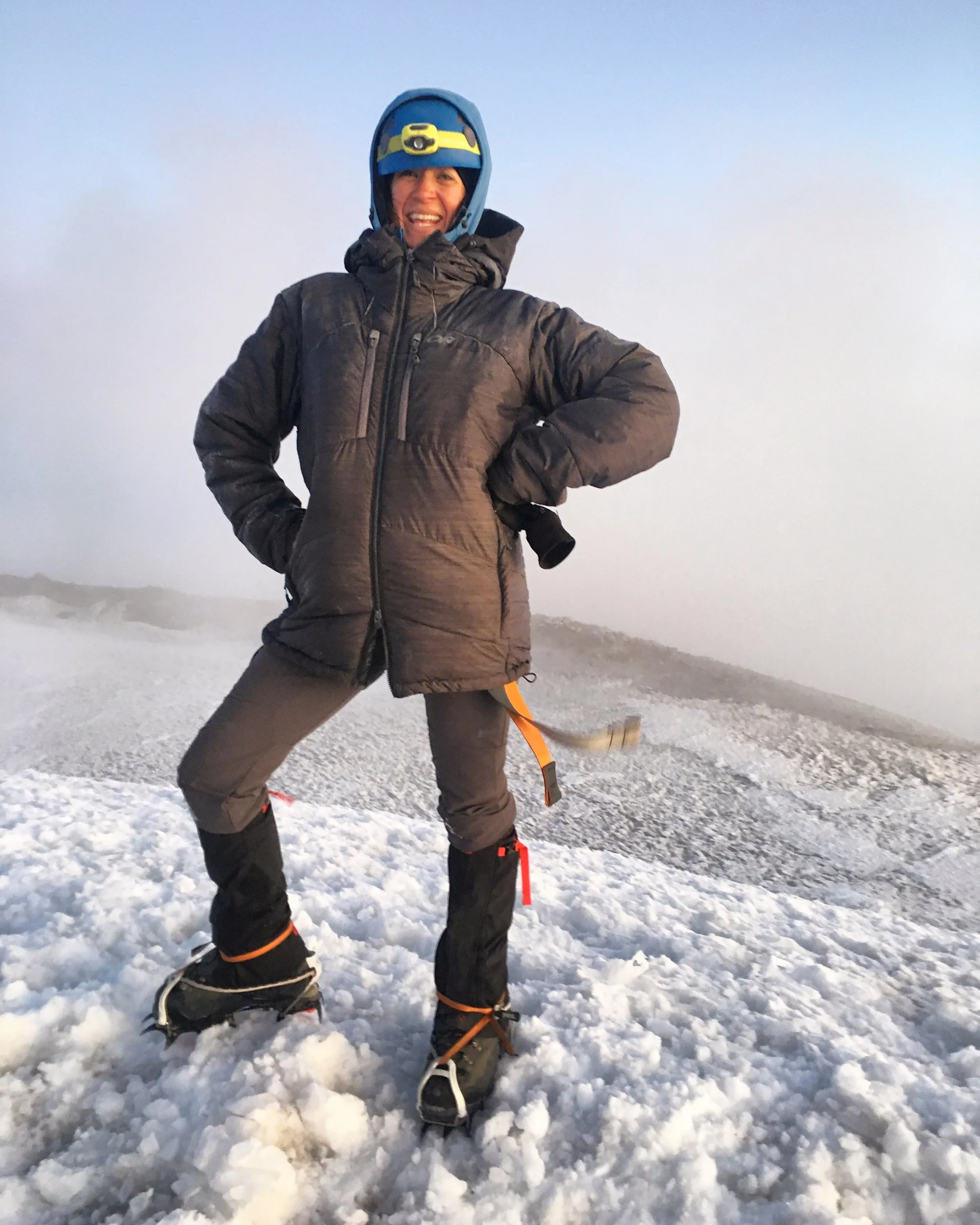
I summited Mt. Rainier in 2019 and had plenty of backcountry jitters that day.
Understand what anxiety looks like for you. Anxiety manifests a little differently for everyone. What are your warning signs? Perhaps it’s negative thoughts, irritability, breathing changes, or a tightness in your chest. When you understand your specific warning signs, you have the opportunity to take a step back, evaluate, and put coping skills into practice before anxiety escalates to a panic.
Breathing skills. I cannot overstate the benefits of intentional breathing for managing anxiety. Your breath is the only physical function that you can directly control, and it is your anchor to the here-and-now.
Box breathing can be especially helpful – inhale to the count of four, hold for four seconds, exhale for four, pause for four. Repeat this continually for a few minutes. Start practicing this in the days or weeks before your climb so that you use this reflexively when you start to feel anxious. You can also pair your breath count with steps to get your mind and body in sync.
Even better, pair the inhale and exhale with a personal mantra that feels grounding or reassuring, such as “I can do hard things” or “one step at a time.”
Control the controllables. Anxiety catapults us into the future, forcing us to think about “what-ifs” instead of “right nows.” While it can indeed be helpful (even life-saving) to be prepared for potential outcomes, it’s equally important to be focused on the step in front of you - literally, the step you are taking.
When anxiety starts to spiral, take a breath and identify one or two actions that you need to do right now – you’ll get to the rest when it’s time.
Label it and share it with someone. I envision anxiety like holding a beach ball underwater, especially when mixed with other emotions such as embarrassment or shame. It requires an increasing amount of focus and pressure to keep it under the surface, yet it shoots up anyways. Giving it a name (“I am feeling anxious”) without judgment is like letting some air out. Sharing how you are feeling with a teammate is a way to let the air out even further. Your team is there to support you!
Remember your “why.” You took time out of your busy schedule to be on the mountain, likely at the expense of other important parts of life (work, family time, etc). What are your reasons for being on the mountain aside from the summit? Remembering your “why” during moments of distress can remind you that it’s not just about how you feel in that moment – it’s part of a larger journey. As a bonus, every struggle you face on the mountain will make it a better story to share later.
Anxiety shows up for everyone on the mountain, from novices to experienced athletes. Anxiety is not a sign of weakness; it’s simply part of taking on new challenges outside of your comfort zone. It’s important to nurture your mental health during big adventures, just as you would your physical health.
With the right care and attention, anxiety can be something that you work with instead of against on your next adventure. And remember– everything you learn about yourself on the mountain can be applied to other parts of life.
This post was originally published on the Alpine Ascents blog, and has been modified slightly.
Author Bio
Dr. Annie Mueller is a licensed clinical psychologist and founder of Summerland Psychology, a private practice serving adults in Washington and PSYPACT states via telehealth. Her work focuses on anxiety, depression, trauma, life transitions, and supporting athletes and high-performing individuals.